
A plane is a tool for shaping wood. Planes are used to flatten, reduce the thickness of, and impart a smooth surface to a rough piece of lumber. As the name implies, the tool turns the worked surface into a smooth plane, a level, even surface.
Wednesday, March 10, 2021

Thursday, February 18, 2021
converting mm to cm to m to km

The method we used to convert our answer is in the picture above. When you convert using multiplication then you move the decimal point to right. the ammount of times you move it is in how much zeros there are in the number your multiplying it by. For example; well convert 70M to km, well move the decimal point three times to the left 70 divided by 1000 we have to divide by 1000, move the decimal point three places to the left on 70 which the answer is 0.070km.
Tuesday, February 16, 2021
5 basic tools in woodwork
Carpenters Pencil
Why is the shape how to sharpen pencil video

Describe - A carpenter pencil (carpentry pencil,
Explain - Hold the carpenter's pencil by the wood. Gently sand BOTH long edges of the lead until you achieve a long, straight, sharp lead edged “V” point. The pencil on the left side of Section “D” in the illustration is properly sharpened.
Marking Gauge:

A marking gauge is used in woodworking to mark out lines for cutting or other purposes. The main purpose is to scribe a line parallel to a reference edge. Link. A marking gauge is generally made out of wood with a metal pin to mark the point. Marking gauge video
sliding bevel:

A sliding T bevel, also known as a bevel gauge or false square is an adjustable gauge for setting and transferring angles. Different from the square, which is fixed and can only set a 90° angle, the sliding T bevel can set any angle and transfer it on another piece. the one in this photo is made out of wood and metal info.
tri square:

A try square or try-square is a woodworking tool used for marking and checking 90° angles on pieces of wood. Though woodworkers use many different types of square, the try square is considered one of the essential tools for woodworking. The square in the name refers to the 90° angle. info
combination set square:

The combination square set (also simply called a “combination set”) is a measuring tool which is designed primarily for measuring angles and lengths. It is used by people working in a number of different trades, including woodworkers and engineers.
How to Convert Meters to Millimeters
Process: Move the decimal point three places to the right or times the meters by 1000 for example:
4.7M x 1000 = 4700mm
22M x 1000 = 22000mm
1M = 1000mm
1M = 100cm
1cm = 10mm
1M = 100x10 = 1000mm
3.72M = 3720mm
4.85M = 4850mm
0.65M = 650mm
8.472M = 8472mm
6.75M = 6750mm
Friday, February 12, 2021
part of a tree
The different parts of a tree are the trunks, bark, crown, roots and leaves. The crown is the top of the tree and I think you know wha
t the leaves, bark, trunks and roots look like so there's no need to explain what they are.
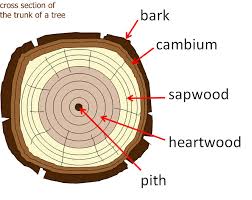
These are the different parts of a trunk. The cambium of the trunk is the growth layer of the tree; it is also what makes the trunk, branches and roots grow thicker. The pith is where all of the water and nutrients go up collected from the roots to help the tree to grow.
Plain sawn, rift sawn and quarter sawn are the three most common ways to cut trees into timber but there are also other ways.
Trees get cut down and then chopped up by a machine called a timber lorry they cut the trees three ways (shown in question above) they then get taken to a timber mill to get cut to its required length.
Defects in timber can be a various amount of things so i'm going to list them below
Wind cracks
Shakes
Twisted fibres
Upsets
Rind galls
Burls
Water stain
Chemical stain
knotting
There are a ton of different trees used to make timber in New Zealand so i'm just going to list a few which are: Rimu, Kauri, Monterey Cyprus, Matai, Rewarewa. Another name for Kauri is Tane Mahuta which is the maori god of the forest. The tree got named this because it is really strong and the biggest type of tree in New Zealand.
converting mm/cm/m
to convert mm to cm we need to divide the mm by 10 which equals cms - 10mm divided by 10 = 1cm
to convert cm to m we need to divide the cms by 100 which equals m - 100cm divided by 100 = 1m
to convert mm to m we need to divide the mm by 1000 which equals m - 1000mm divided by 1000 = 1m
Thursday, February 11, 2021
Convert millimeters to meters
Today in maths we learnt how to convert millimeters into meters. we learnt this by moving the decimal point three spaces from right to left no matter how high the nubmer is. For example. 4000 that would be four meters. 270000 that would be 270 meters! we learnt this by dividing our centermeters that we had by 1000 and next lesson well learn how to do it the other way around which is multiplying our meters by 1000 to see how much millimeters well get.
Subscribe to:
Posts (Atom)